
GUEST SPEAKER - OZ SOXX - Alex & Jason Andrew
The idea originated after seeing similar products used extensively in the United States.
Most erosion control socks in Australia are filled with coir (coconut fibre) imported from Sri Lanka and India.
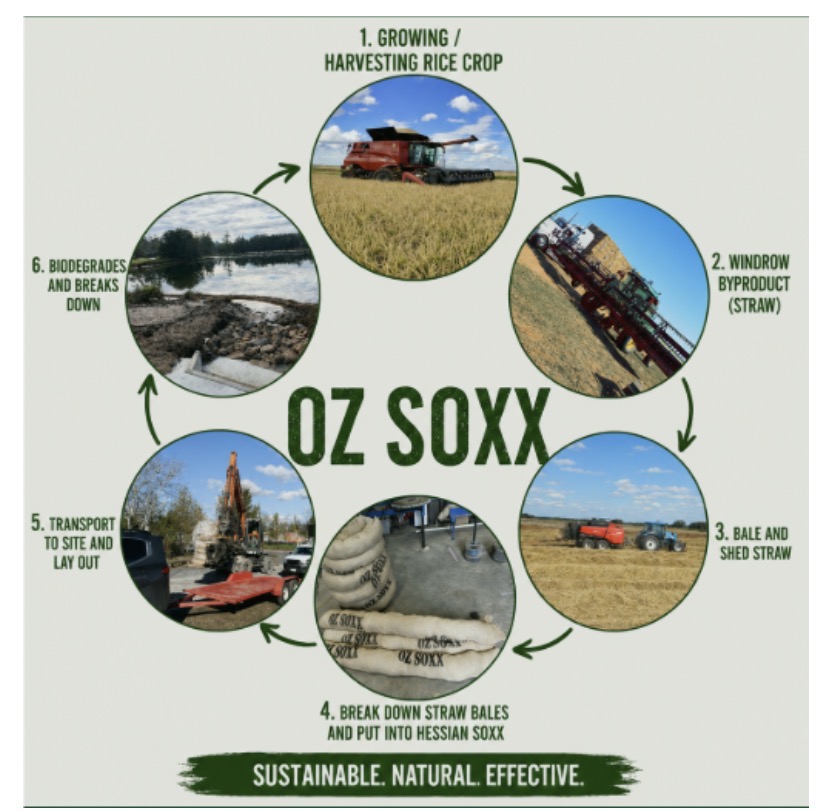
Oz Soxx has developed a product using Australian rice straw, creating a local alternative while reducing reliance on imported materials.
Rice straw is packed into biodegradable hessian socks used to:
Control erosion. Filter sediment from stormwater. Protect waterways and drainage systems. Stabilise construction sites and embankments.
The socks are designed to be up to 8 metres long, making installation more efficient than shorter, heavier products.
The product can also be used in urban developments and environmental rehabilitation projects.
Made entirely from biodegradable materials with no plastic components.
Leaves no lasting environmental footprint once it breaks down.
Supports the principles of the circular economy by turning agricultural waste into a valuable product.
Rice straw is often burnt because it is difficult to manage after harvest.
Demonstrations showed the product effectively filtering dirty water before it enters waterways.
Developing the manufacturing process involved significant trial and error:
Finding suitable equipment to chop rice straw.
Initial processing methods were slow, dusty and inefficient.
Various grinders and machinery were tested before achieving acceptable production rates.
Trial sites have been established in: Richmond (Sydney), Canberra, Redlands (south of Brisbane), Geelong.
These trials are helping validate the product's performance under Australian conditions.
Progress accelerated after connecting with the International Erosion Control Association (IECA) Australasia.
Through these industry contacts, the business: Received valuable technical advice. Connected with major civil contractors.
Introduced the product to Tier 1 construction companies including organisations such as John Holland
Found strong interest from companies seeking environmentally friendly alternatives to plastic erosion control products.
Major infrastructure projects in Queensland, particularly those associated with Olympic Games developments.
Growing pressure to eliminate plastic erosion control products.
Increasing environmental regulations around sediment and erosion control.
A Geelong-based company is also considering distributing and marketing the product nationally.
Current challenges include: Scaling manufacturing. Improving transport and logistics. Remaining price competitive with imported products. Building credibility in a conservative construction industry where specification by engineers is critical.